Mr. Cowherd is 4-6 ATS this year…
Colin Cowherd’s Blazing 5 Picks for NFL Week 3 2021
September 24, 2021 by
Understanding DFS Point Scoring
September 23, 2021 by
 Introduction
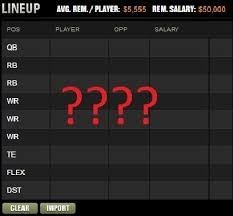
Daily fantasy sports are much more action-packed than traditional fantasy sports. It happens across a much shorter timeframe too, but this can confuse how DFS games are scored. The Internet has created massive communities oriented around every sport and the fantasy playoffs in them.
We’re focusing on fantasy football scoring here, the most popular form of fantasy sports that is played in America. You can see NFL daily fantasy sports in action online. Here we have information on how those fantasy games are commonly scored, along with pertinent definitions that beginners will want to know.
DFS Point Scoring
Here’s a rundown of how different events in a game are scored under generalized DFS rules. Remember that the specific rules may change depending on who you’re using to manage your fantasy sports games.
| Rushing yards made = 0.1 points | 0 points allowed = 10 points |
| Rushing touchdowns = 6 points | 1-6 points allowed = 7 points |
| Passing yards made = 0.04 points | 7-13 points allowed = 4 points |
| Passing touchdowns = 4 points | 14-20 points allowed = 1 point |
| Receiving yards = 0.1 points | 21-27 points allowed = 0 points |
| Receiving touchdowns = 6 points | 28-34 points allowed = -1 point |
| Return touchdowns = 6 points | 35+ points allowed = -4 points |
| Safeties = 2 points | Field goals from 0-39 yards = 3 points |
| Sacks = 1 point | Field goals from 40-49 yards = 4 points |
| Interceptions = -1 point | Field goals from 50+ yards = 5 points |
| Interceptions made = 2 points | |
| Receptions = 0.5 points | |
| Blocked punt/kick = 2 points | |
| Fumbles lost = -2 points | |
| Fumbles recovered after touchdowns = 6 points | |
| Opponent fumbles recovered = 2 points | |
| Kickoff return touchdowns = 6 points | |
| Punt return touchdowns = 6 points | |
| Two-point conversion passes = 2 points | |
| Two-point conversions scored = 2 points | |
| Extra-point conversions = 1 point | |
| Extra point return = 2 points |
Important Definitions
To properly understand daily fantasy sports, you should know some important definitions that enable you to figure out what’s going on. Here are several:
$/Point: The salary of players, divided by how many fantasy points they score.
50/50: Where half the field is paid evenly, usually double the entrance fee.
Algorithm/Model/Projection: Terms for the equations used to calculate players’ statistical performances in a game.
Balance: A lineup that’s filled with mid-price range players.
Bankroll: The money you use when betting or playing fantasy sports.
Ceiling: The max points expected from a player based on past performances.
Chalk: A player/team/game expected to be popular with the crowd.
Dart Throw: A longshot play that relies on a player reaching a higher target score.
Double-Up: Contests where your entry fee is doubled if you’re in the top 50%.
Fish: A new (and inexperienced) DFS player.
Field Size: The number of people in a contest.
Floor: Opposite of ceiling, the lowest points expected from a player based on past performances.
Guaranteed Prize Pool: Tournaments with a guaranteed minimum prize pool.
High Stakes: Contests with a higher entry fee, typically $50.
Head-To-Head: A contest between two DFS players, one on one.
Late Swap: When you can switch players in and out after the first game has begun.
Lean: A preference towards one position over others, e.g., you lean X player over Y player.
Min Salary: The minimum amount a player costs on the site.
Mass Multi-Entry: A.K.An MME, where DFS players enter lineups into a contest until they hit the maximum limit.
Multi-Entry: Where one enters more than one lineup into a contest.
Overlay: When a tournament pays out more money than they receive.
Pay Up: To choose high-price players instead of mid or lower ones.
Player Prop Bet: Oddsmaker lines that focus on one player and their performance.
Punt: Lower-priced players that could be successful but are also disposable.
Quintuple Up: Where the contest payout is five times the entry fee.
Reach: A chosen player/play expected to make an unexpectedly good performance.
ROI: Return On Investment, how much money you make on your initial investment.
Sharks: Experienced DFS players who know what they’re doing.
Single-Entry: Contests with one entry limit.
Sleeper: Players being overlooked who could make a good play.
Stacking: Choosing multiple players from the same teams/games.
Tilt: Disappointment/frustration felt by bettors and DFS players whose positions don’t pay off.
Tournament: Competition between many players. In DFS, tournaments don’t usually have tiers like they traditionally do.
Train: When a DFS player enters the same lineup multiple times into multi-entry games.
Triple-Up: Tournaments that payout three times the entry fee to each winner, similar to double-ups and quintuple-ups.
Upside: The expectation that a player will exceed the projections given by oddsmakers/DFS hosts.
Value: Players that should be priced higher than they are due to certain opportunities.
Viable: When a player has a reasonable expectation of reaching their target score.
8:20 p.m. ET: Carolina Panthers at Houston Texans 9-23-21 Smackdown!
September 23, 2021 by
The Panthers (2-0 SU, 2-0 ATS) have been impressive through two games, taking care of the Jets 19-14 as 3.5-point home favorites in the opener and then upsetting the Saints 26-7 last week as 3-point home dogs. Meanwhile, the Texans (1-1 SU, 2-0 ATS) have also covered both of their games thus far, upsetting the Jags 37-21 as 3.5-point home dogs and then losing to the Browns 31-21 last week but covering as 13.5-point road dogs. This line opened with Carolina listed as a 7-point road favorite. A combination of early sharp money and steady public support has pushed Carolina up from -7 to -8. Before Tyrod Taylor got hurt, the early line was Carolina -3.5. With rookie Davis Mills starting, the opener was adjusted to -7.
If you missed the early number on the Panthers, the Texans could be worth a look as a buy-low value play. The public is all over Carolina, which gives Houston contrarian value in a heavily bet primetime game, plus an inflated line at 8. Dogs are 21-11 ATS (66 percent) this season. Primetime dogs are 4-2 ATS this season and 32-21 (60 percent) since 2020. Alex Kemp, the lead official, has historically favored home teams (27-20, 58 percent ATS).
If you like the Panthers, consider them in a teaser. You could tease Carolina down from -8 to -2, which goes through a pair of key numbers in 7 and 3. Going through multiple key numbers is the wiseguy approach to teasers.
The total opened at 44 and despite the public taking the over, the line has fallen to 43. This reverse line movement signals some smart under money. One interesting trend we’ve seen this season: primetime overs are a perfect 6-0.
(VSIN.Com)